|
4.5 on
Bundle & Save 25%
|
23,000 reviews
|
Recommended by over 300 expert nutritionists

20% OFF APPLIED

The science behind Feel Pro Collagen Type 2

Feel Pro Collagen Type 2 for Joints gives your body the building blocks of type 2 collagen, the main protein of joint cartilage: 18 amino acids in the proportions found in human type 2 collagen, with vitamin C, turmeric and elderberry. This page shows what the research found, with each study’s own numbers: in a 12-week study of 10 adults, with no comparison group, their joint questionnaire score was 58% lower than at the start.

Feel Pro Collagen Type 2 tub with sliced mango, vanilla pods, a vanilla flower and a scoop of the powder on a yellow ground

How it works

What is type 2 collagen, and what is in Pro Collagen Type 2?

Explainer

Inside a joint, step by step

How cartilage is built, and where the formula’s building blocks come in. Follow the numbers on each drawing; tap a step, or play all five.

About each step

Cartilage cushions the jointwhere type 2 collagen lives

Where two bones meet, their ends are covered by smooth cartilage, 2 to 4 mm thick, that lets them glide and spreads the load. Cartilage has no blood vessels or nerves: its cells are fed by the joint fluid, which seeps in. Up to 80% of cartilage is water. Of the rest, about 60% is collagen, and 90% to 95% of that collagen is type 2.

Type 2 collagen up closethree chains in one helix

Type 2 collagen is made of three identical chains of amino acids, wound together. Glycine, the smallest amino acid, sits at every third place along each chain, and proline is among the most common of the others. The fibres hold water-loving proteoglycans in place, which lets cartilage take a load and spring back.

From the glass to the jointfree amino acids

One 6 g serving holds 5.1 g of the Type 2 blend: 18 amino acids in the proportions found in human type 2 collagen, with elderberry extract, turmeric extract and vitamin C. The amino acids are already free, so the gut does not need to break them down before taking them up. The formula contains no collagen from animals.

Cartilage cells at workchondrocytes

Chondrocytes make up only about 2% of cartilage, yet they build and maintain everything around them. In the maker’s laboratory tests, cartilage cells given the formula raised the activity of their type 2 collagen gene by up to 50% and released more glycosaminoglycans, the family that includes chondroitin and hyaluronic acid. These are results in cells, not in people.

What the study measured10 adults, 12 weeks

In the maker’s study, 10 adults with joint discomfort or a high risk of fractures took 5 g a day for 12 weeks. Their WOMAC score, a questionnaire on joint pain, stiffness and everyday movement, was 41.2% lower than at the start after 4 weeks and 58.0% lower after 12 weeks. Everyone took the formula and there was no comparison group, so the study cannot show how much of the change came from it.

Drawn by Feel, not to scale. Cartilage facts from Sophia Fox et al. 2009 and Martínez-Puig et al. 2023; the cell and human results from the report and the white paper from the ingredient’s maker (the week 4 scores are from the white paper), neither of them peer-reviewed.

Explainer

Cartilage in four numbers

  • 80%of its weight can be water
  • 60%of the rest is collagen
  • 90–95%of that collagen is type 2
  • 2%of cartilage is cells

From Sophia Fox et al. 2009, a review of how joint cartilage is built: water up to 80% of its wet weight, collagen about 60% of its dry weight.

Picture

Two collagens, two jobs

The body makes 28 types of collagen; these two are the most common.

  • Type 1 collagenSkin, bone, tendons and ligaments
    • Two identical chains and one different
    • More than 90% of the organic matter in bone, skin, tendons and ligaments
    • The profile in Feel Pro Collagen, for skin
  • Type 2 collagenJoint cartilage
    • Three identical chains
    • About 80% of the collagen in cartilage
    • The profile in Pro Collagen Type 2, for joints

From Martínez-Puig et al. 2023, the review in study 3. Collagen types differ in their chains and in where the body uses them.

Start here

Three key takeaways from the research

  1. Joint scores fell in a 12-week study

    −58%WOMAC joint questionnaire score after 12 weeks, against the start

    10 adults took 5 g a day; their score was already 41.2% lower at week 4. The questionnaire covers joint pain, stiffness and everyday movement. There was no comparison group.

    See the questionnaire results
  2. Cartilage cells made more

    up to +50%activity of the type 2 collagen gene, in cartilage cells in the laboratory

    The cells also released more glycosaminoglycans, and three inflammation signals were lower. These are laboratory results, not results in people.

    See the laboratory tests
  3. Vitamin C for collagen

    191%of the vitamin C reference intake in one serving: 153 mg

    Vitamin C contributes to normal collagen formation for the normal function of cartilage and bones: an approved health claim.

    See the ingredients

The short answer

What does the research show? Four findings

In plain wordsFeel Science Team

Pro Collagen Type 2 gives the building blocks of type 2 collagen, the main collagen of joint cartilage, with vitamin C. In the maker’s study, 10 adults with joint discomfort or a high risk of fractures took 5 g a day of its main ingredient for 12 weeks: their WOMAC score, a questionnaire on joint pain, stiffness and everyday movement, was 58.0% lower than at the start, and a blood marker of bone breakdown was 19.7% lower. In the maker’s laboratory tests, cartilage cells given the formula raised the activity of their type 2 collagen gene by up to 50%. In the maker’s own comparison of 75 trials of joint supplements, the 12-week fall in the joint score was the 5th largest of 44 supplement groups; that comparison sets separate studies side by side and is not a head-to-head test. The study had no comparison group and none of the maker’s reports is peer-reviewed, so these are early results. Vitamin C contributes to normal collagen formation for the normal function of cartilage and bones.

Chart

Joint scores after 12 weeks, in one picture

How much lower each part of the WOMAC score was than at the start, in 10 adults.

Stiffness−66.7%
Everyday movement−60.5%
Joint discomfort−44.0%
Total score−58.0%

Drawn by Feel from the maker’s report: 10 adults, 5 g a day, no comparison group. A lower score means milder symptoms. The report marks the fall in the total score as statistically significant against the start.

Chart

The amount tested, and the amount in a serving

Grams of the Type 2 blend a day.

In the 12-week study5 g
In one serving of Pro Collagen Type 25.1 g

From the maker’s report (one 5 g sachet a day) and the Pro Collagen Type 2 label (5.1 g in each 6 g serving).

What these studies did not testFeel Science Team

The 12-week study had no placebo group, so it cannot separate the formula’s effect from time, expectation or other habits; it has not been published in a journal. The cell tests show what happened in laboratory dishes, not in a joint. The published trials of collagen for joints tested other ingredients: native type 2 collagen from chicken, or hydrolysed collagen.

In short

The studies in human terms, and what they found

In human terms

Think of cartilage as the cushion on the ends of your bones, woven from type 2 collagen and soaked with water. The cells that keep it in repair need building blocks, and vitamin C to turn them into collagen. Pro Collagen Type 2 gives those building blocks in one drink a day. In a small 12-week study, adults with joint discomfort rated their joint pain, stiffness and everyday movement as less of a problem, and in laboratory dishes, cartilage cells switched on their collagen gene. What has not been done yet is a trial with a placebo group, which would show how much of the change came from the formula.

  1. StartBone scans, a blood test and the joint questionnaire
  2. Every dayOne 5 g sachet before a meal
  3. Week 4The joint questionnaire again
  4. Week 12Joint score 58.0% lower; bone breakdown marker 19.7% lower

The studies at a glance

The research behind Pro Collagen Type 2 is early. The maker of its main ingredient tested it in cartilage, bone and immune cells in the laboratory, and in 10 adults for 12 weeks; neither report has been peer-reviewed or published in a journal. A 2023 review in the journal Nutrients explains what type 2 collagen is and how collagen ingredients for joints have been tested, and a 2009 review in Sports Health describes how cartilage is built. The maker also set the 12-week joint score next to 75 published trials of other joint supplements. Vitamin C, which the formula contains, has an approved claim for collagen formation in cartilage and bones.

  • Joint score 58.0% lowerWOMAC questionnaire after 12 weeks, against the start, in 10 adults with no comparison group.
  • Stiffness 66.7% lowerThe stiffness part of the same questionnaire fell the most.
  • Collagen gene up to 50% more activeIn cartilage cells in the laboratory, against untreated cells.
  • More chondroitin and hyaluronic acidCartilage cells released more glycosaminoglycans in the laboratory.
  • Bone breakdown marker 19.7% lowerCTx in the blood after 12 weeks, in 8 adults.
  • Vitamin C for collagen153 mg a serving; it contributes to normal collagen formation for cartilage and bones.

The joint questionnaire

WOMAC, the joint score: what changed, and how it compares

WOMAC is one of the questionnaires joint studies use most. What it asks, how the scores moved week by week in the Type 2 blend study, and where that result sits next to other joint supplements tested with the same questions.

  • 24questions on pain, stiffness and everyday movement
  • −41.2%in the total score by week 4
  • −58.0%in the total score by week 12
  • 5thof 44 supplement groups at 12 weeks, in the maker’s comparison
Explainer

What the questionnaire asks

24 questions in three parts, about the last few days. Each answer is scored from 0 to 4 and the points are added up.

  • 5 questions on painWalking, going up or down stairs, at night in bed, sitting or lying, and standing.0 to 20 points
  • 2 on stiffnessOn first waking, and later in the day after sitting or resting.0 to 8 points
  • 17 on everyday movementStairs, getting up from a chair or out of bed, bending to the floor, walking, getting in or out of a car or a bath, shopping, putting on socks, and housework.0 to 68 points

Each answer

  1. 0None
  2. 1Slight
  3. 2Moderate
  4. 3Severe
  5. 4Extreme

All 24 answers added up: 0 to 96 points. Lower means milder.

Feel’s summary of the questionnaire’s topics, from the study that tested it (Bellamy et al., 1988). Some studies mark each answer on a 0-to-100 line instead of five boxes; showing every result as a percentage of its own start puts both on one scale.

Chart

Week by week, in the Type 2 blend study

How much lower each score was than at the start, at week 4 and at week 12. Longer bars mean a bigger fall.

  • Week 4
  • Week 12

Total score

Week 4−41.2%
Week 12−58.0%

Joint discomfort

Week 4−36.0%
Week 12−44.0%

Stiffness

Week 4−33.3%
Week 12−66.7%

Everyday movement

Week 4−44.7%
Week 12−60.5%

Drawn by Feel from the maker’s report and white paper: 10 adults, 5 g a day, no comparison group. Week 8 was not measured.

Chart

Next to other joint supplements, on the same questionnaire

How far each group’s score fell from its own start, visit by visit: the Type 2 blend in violet, and eight studies of turmeric, glucosamine, methylsulfonylmethane (MSM) and collagen supplements in grey. Lower is better. Tap a supplement to pick out its line.

  • The Type 2 blend
  • Eight other supplement studies
  • The one you pick

Total score

See the numbers
Total score: change from the start at each visit
Supplement, each dayChange from the start
The Type 2 blend 5 gweek 4: −41.2%; week 12: −58.0%
Turmeric extract (curcuminoids) 500 mgday 7: −7.9%; day 15: −17.0%; day 30: −31.8%; day 60: −51.3%
Curcuminoids from turmeric 1.5 g, in three dosesweek 6: −41.0%
Turmeric extract with glucosamine sulfate 1 g of the extract and 1.5 g of glucosamine sulfateday 21: −22.1%; day 42: −40.4%
Glucosamine sulfate 1.5 gweek 4: −5.2%; week 8: −21.6%; week 12: −35.0%
Methylsulfonylmethane (MSM) 6 g, as 3 g twice a dayweek 12: −25.2%
Methylsulfonylmethane (MSM), lower amount 3.4 g, in three dosesweek 6: −10.5%; week 12: −18.6%
Native type 2 collagen from chicken 40 mgday 7: −6.9%; day 30: −15.9%; day 60: −21.6%; day 90: −27.8%; day 120: −33.1%; day 150: −36.0%; day 180: −40.3%
Hydrolysed collagen with chondroitin, glucosamine and plant extracts 1.5 g of hydrolysed collagen, in 3 tabletsmonth 3: −29.2%; month 6: −52.0%

Joint discomfort

See the numbers
Joint discomfort: change from the start at each visit
Supplement, each dayChange from the start
The Type 2 blend 5 gweek 4: −36.0%; week 12: −44.0%
Turmeric extract (curcuminoids) 500 mgday 7: −10.7%; day 15: −19.9%; day 30: −29.6%; day 60: −48.1%
Curcuminoids from turmeric 1.5 g, in three dosesweek 6: −38.4%
Glucosamine sulfate 1.5 gweek 4: −4.7%; week 8: −21.2%; week 12: −40.3%
Methylsulfonylmethane (MSM) 6 g, as 3 g twice a dayweek 12: −25.2%
Methylsulfonylmethane (MSM), lower amount 3.4 g, in three dosesweek 6: −16.3%; week 12: −19.8%
Native type 2 collagen from chicken 40 mgday 7: −6.7%; day 30: −15.8%; day 60: −21.9%; day 90: −28.2%; day 120: −34.3%; day 150: −37.0%; day 180: −41.3%
Hydrolysed collagen with chondroitin, glucosamine and plant extracts 1.5 g of hydrolysed collagen, in 3 tabletsmonth 3: −24.8%; month 6: −50.2%

Stiffness

See the numbers
Stiffness: change from the start at each visit
Supplement, each dayChange from the start
The Type 2 blend 5 gweek 4: −33.3%; week 12: −66.7%
Turmeric extract (curcuminoids) 500 mgday 7: −8.0%; day 15: −22.1%; day 30: −37.2%; day 60: −53.1%
Curcuminoids from turmeric 1.5 g, in three dosesweek 6: −85.7%
Glucosamine sulfate 1.5 gweek 4: −2.4%; week 8: −21.9%; week 12: −27.2%
Methylsulfonylmethane (MSM) 6 g, as 3 g twice a dayweek 12: −19.7%
Methylsulfonylmethane (MSM), lower amount 3.4 g, in three dosesweek 6: −16.1%; week 12: −22.9%
Native type 2 collagen from chicken 40 mgday 7: −7.3%; day 30: −16.0%; day 60: −22.5%; day 90: −29.3%; day 120: −34.4%; day 150: −36.7%; day 180: −41.0%
Hydrolysed collagen with chondroitin, glucosamine and plant extracts 1.5 g of hydrolysed collagen, in 3 tabletsmonth 3: −33.2%; month 6: −51.6%

Everyday movement

See the numbers
Everyday movement: change from the start at each visit
Supplement, each dayChange from the start
The Type 2 blend 5 gweek 4: −44.7%; week 12: −60.5%
Turmeric extract (curcuminoids) 500 mgday 7: −7.0%; day 15: −15.1%; day 30: −31.5%; day 60: −52.1%
Curcuminoids from turmeric 1.5 g, in three dosesweek 6: −41.2%
Glucosamine sulfate 1.5 gweek 4: −8.2%; week 8: −21.7%; week 12: −37.1%
Methylsulfonylmethane (MSM) 6 g, as 3 g twice a dayweek 12: −30.5%
Methylsulfonylmethane (MSM), lower amount 3.4 g, in three dosesweek 6: −8.3%; week 12: −17.0%
Native type 2 collagen from chicken 40 mgday 7: −6.7%; day 30: −15.9%; day 60: −20.4%; day 90: −25.9%; day 120: −30.7%; day 150: −34.3%; day 180: −38.6%
Hydrolysed collagen with chondroitin, glucosamine and plant extracts 1.5 g of hydrolysed collagen, in 3 tabletsmonth 3: −30.0%; month 6: −52.5%

Pick out one supplement

Drawn by Feel from the maker’s comparison (study 5), with each study checked against its paper on PubMed. Every line is one group’s change from its own start: the studies differ in people, length and design, so this is not a head-to-head test. Glucosamine is drawn while people took it. The maker’s chart lists the curcuminoid trial twice, the second time from a later paper on blood tests; it is drawn once here. In that trial, stiffness started very low, so a small change made a large percentage.

Chart

At 12 weeks, among 44 supplement groups

Every group in the maker’s comparison that took a supplement on its own and had a total score at 12 or 13 weeks, from the largest fall to the smallest. The Type 2 blend’s fall was the 5th largest.

  • The Type 2 blend
  • Native type 2 collagen (8 groups)
  • Other supplements
See all 44 groups
Fall in the total score at 12 or 13 weeks, by what each group took
RankWhat the group tookChange
1Native type 2 collagen−81.7%
2Native type 2 collagen−75.0%
3Glucosamine sulfate−74.7%
4Native type 2 collagen−65.0%
5The Type 2 blend−58.0%
6Hydrolysed bovine collagen, 10 g−56.0%
7Native type 2 collagen−52.3%
8Collagen peptides−49.9%
9Turmeric with glucosamine−49.7%
10Eggshell membrane−49.0%
11Beta-glucan with glucosamine−43.7%
12Curcumin−43.6%
13Type 1 collagen−43.3%
14Boswellia with glucosamine−42.9%
15Krill oil, astaxanthin and hyaluronic acid−42.3%
16Bovine collagen peptides−42.1%
17Glucosamine with chondroitin−38.9%
18Native type 2 collagen−37.7%
19Beta-glucan with glucosamine−37.1%
20Glucosamine with chondroitin−35.5%
21Glucosamine, chondroitin and MSM−35.5%
22Glucosamine sulfate−35.0%
23Glucosamine with chondroitin−34.7%
24Herbal blend−33.3%
25Native type 2 collagen−33.0%
26Pork collagen peptides−30.7%
27Glucosamine−30.2%
28Glucosamine sulfate−30.1%
29Glucosamine sulfate−29.9%
30Hydrolysed collagen with chondroitin and glucosamine−29.2%
31Native type 2 collagen−27.8%
32Krill oil−27.1%
33Glucosamine with chondroitin−26.4%
34Herbal blend−25.8%
35MSM−25.2%
36Glucosamine with chondroitin−24.2%
37Curcumin with boswellia−22.3%
38Glucosamine with chondroitin−22.3%
39Curcumin−21.9%
40MSM−18.6%
41Native type 2 collagen−17.4%
42Glucosamine, chondroitin and S-adenosylmethionine (SAMe)−17.0%
43Glucosamine with chondroitin−14.0%
44Glucosamine, chondroitin and S-adenosylmethionine (SAMe)−8.1%

Drawn by Feel from the maker’s comparison (study 5). Groups that also took medicines or had exercise or physiotherapy are left out. The 8 groups that took native type 2 collagen ranged from 17.4% to 81.7% lower: results for one ingredient differ widely between studies.

In plain wordsFeel Science Team

In the Type 2 blend study, the joint questionnaire score was 41.2% lower than at the start after 4 weeks and 58.0% lower after 12 weeks; stiffness fell the most. In the maker’s comparison, 44 supplement groups had a total score at 12 weeks: 4 fell more than the Type 2 blend and 39 fell less, and the middle result was 34.9% lower. These are falls from each group’s own start, in different people and different studies, and the Type 2 blend’s study had no placebo group. So the comparison shows where its result sits among other studies; only a trial with a placebo group can show how much of the fall the blend itself caused.

Explainer

How to read these comparisons

Four things to keep in mind before reading a chart that sets separate studies side by side.

  • Each group against its own start

    Every line and column shows how much one group’s score fell from its own start. No study gave the Type 2 blend and another supplement to similar people at the same time, so these charts cannot say which works better.

  • People improve on a placebo too

    In 198 trials in people with osteoarthritis, groups given only a placebo also reported less pain and stiffness and easier movement (Zhang et al., 2008). Seven of the eight other studies in the line chart had a placebo group; the Type 2 blend’s study did not.

  • What a fair test adds

    When collagen supplements were tested against a placebo, the total score fell 8.00 points more with collagen than with the placebo, in a 2019 review of those trials (García-Coronado et al.). A placebo group is how a study shows what the supplement itself added.

  • Who put it together

    The maker of the Type 2 blend collected these results (study 5); its comparison has not been peer-reviewed. Feel checked each study in the line chart against its paper on PubMed.

Explainer

The nine studies in the line chart

Each study’s total score at its last visit. Open one to see what was taken, how the study was run and who took part, as Feel checked it on PubMed.

  • The Type 2 blend, 5 g12 weeksNo placebo group−58.0%week 12
    What they took
    The Type 2 blend: 5 g a day
    Taken for
    12 weeks
    Design
    One group, compared with its own start; no placebo group
    People
    10 adults with joint discomfort or a high risk of fractures

    The maker’s report (study 1); not peer-reviewedSee study 1

  • Turmeric extract, 500 mg60 daysWith a placebo group−51.3%day 60
    What they took
    Turmeric extract (curcuminoids): 500 mg a day
    Taken for
    60 days
    Design
    Randomised, double-blind, with a placebo group
    People
    50 adults with knee osteoarthritis; 46 finished

    Panda et al. · BioMed Research International · 2018DOIPubMed

  • Curcuminoids, 1.5 g6 weeksWith a placebo group−41.0%week 6
    What they took
    Curcuminoids from turmeric: 1.5 g, in three doses a day
    Taken for
    6 weeks
    Design
    Randomised, double-blind, with a placebo group; a pilot trial
    People
    40 adults with knee osteoarthritis

    Panahi et al. · Phytotherapy Research · 2014DOIPubMed

  • Turmeric and glucosamine42 daysWith a placebo group−40.4%day 42
    What they took
    Turmeric extract with glucosamine sulfate: 1 g of the extract and 1.5 g of glucosamine sulfate a day
    Taken for
    42 days
    Design
    Randomised, single-blind, with a placebo group
    People
    120 adults with knee osteoarthritis, in 4 groups

    Madhu et al. · Inflammopharmacology · 2013DOIPubMed

  • Glucosamine sulfate, 1.5 g12 weeksWith a placebo group−35.0%week 12
    What they took
    Glucosamine sulfate: 1.5 g a day
    Taken for
    12 weeks, then 12 weeks without it
    Design
    Randomised, double-blind, with a placebo group
    People
    60 adults with knee osteoarthritis

    Giordano et al. · Current Therapeutic Research · 2009DOIPubMed

  • MSM, 6 g12 weeksWith a placebo group−25.2%week 12
    What they took
    Methylsulfonylmethane (MSM): 6 g, as 3 g twice a day a day
    Taken for
    12 weeks
    Design
    Randomised, double-blind, with a placebo group; a pilot trial
    People
    50 adults with knee osteoarthritis pain

    Kim et al. · Osteoarthritis and Cartilage · 2006DOIPubMed

  • MSM, 3.4 g12 weeksWith a placebo group−18.6%week 12
    What they took
    Methylsulfonylmethane (MSM), lower amount: 3.4 g, in three doses a day
    Taken for
    12 weeks
    Design
    Randomised, double-blind, with a placebo group
    People
    49 adults with knee osteoarthritis

    Debbi et al. · BMC Complementary and Alternative Medicine · 2011DOIPubMed

  • Native type 2 collagen, 40 mg180 daysWith a placebo group−40.3%day 180
    What they took
    Native type 2 collagen from chicken: 40 mg a day
    Taken for
    180 days
    Design
    Randomised, double-blind, with a placebo group and a glucosamine and chondroitin group
    People
    191 adults with knee osteoarthritis, in 3 groups

    Lugo et al. · Nutrition Journal · 2016DOIPubMed

  • Collagen, chondroitin, glucosamine6 monthsNo placebo group−52.0%month 6
    What they took
    Hydrolysed collagen with chondroitin, glucosamine and plant extracts: 1.5 g of hydrolysed collagen, in 3 tablets a day
    Taken for
    6 months
    Design
    Open, one group; no placebo group
    People
    130 adults with knee or hip osteoarthritis; 78 finished

    Puigdellivol et al. · Journal of Dietary Supplements · 2019DOIPubMed

Seven were randomised trials with a placebo group; one was an open study with no placebo group; the Type 2 blend’s study compared people with their own start. The amounts are those each group took every day.

Study 1 · The maker’s human study

The 12-week study: 10 adults, 5 g a day

Explainer

Study 1 in four numbers

  • 10adults over 20
  • 5 gof the Type 2 blend a day
  • 12weeks, with a check-in at week 4
  • 4measures: a questionnaire, two bone scores and a blood marker

From the maker’s report on the Type 2 blend.

Flowchart

How the study was run

  1. 10 adults joinedOver 20, with joint discomfort or a high risk of fractures: low bone density, after the menopause, or aged 65 or over.
  2. One sachet a day5 g of the Type 2 blend before a meal, for 12 weeks.
  3. Measured at the start and at week 12Bone scans of the spine (DEXA), a blood test, and the joint questionnaire, also at week 4.
  4. Compared with their own startEveryone took the formula: there was no placebo group.

From the maker’s report. DEXA is a low-dose X-ray scan that measures bone density.

Chart

The joint questionnaire, from the start to week 12

Each part of the WOMAC score, with the start set at 100. Lower means milder symptoms.

  • Start (100)
  • Week 12
Joint discomfort−44.0% by week 12
Stiffness−66.7% by week 12
Everyday movement−60.5% by week 12
Total score−58.0% by week 12

Drawn by Feel from the maker’s report (10 adults). WOMAC, the Western Ontario and McMaster Universities Osteoarthritis Index, is a standard questionnaire on joint pain, stiffness and everyday movement.

In plain wordsFeel Science Team

After 12 weeks, the average WOMAC score was 58.0% lower than at the start. Of its three parts, stiffness fell by 66.7%, everyday movement (physical function) by 60.5% and pain by 44.0%. The report marks the fall in the total score as statistically significant against the start. Everyone in the study took the formula, so there is nothing to compare these changes with: some of the change could have happened without it.

Chart

Bone markers, at the start and at week 12

Spine scans and a blood test, in the adults who had them. Higher bone scores mean denser bone; a lower CTx means less bone breakdown.

  • Spine bone density, against young adults (T-score)Start−0.66Week 12−0.469 adults; 7 of 9 rose.
  • Spine bone density, against people of the same age (Z-score)Start0.178Week 120.6449 adults; all 9 rose.
  • Bone breakdown marker in the blood (CTx)Start0.493Week 120.396ng/mL; 19.7% lower. 8 adults; 7 of 8 fell.

From the maker’s report, which marks all three changes as statistically significant against the start. The report’s 30.3% is the change in the T-score, not in bone density itself. Bone density is usually followed over a year or more, and these are 12-week readings without a comparison group.

The source, as publishedMaker’s report

VeCollal Type 2: Clinical Trial Result

  • Who10 adults over 20
  • DesignOne group, before and after
  • MeasuredWOMAC, spine bone scores, CTx
  • PublishedCompany report, not peer-reviewed
In short

Summarised by Feel: after 12 weeks of 5 g a day, scores for joint pain, stiffness and everyday movement were lower than at the start, and spine bone scores and a blood marker of bone breakdown changed, all against the participants’ own start. Read the report (PDF).

The full record9 lines: authors, design, results
Title
VeCollal Type 2: Clinical Trial Result
Authors
Not given. A report from the maker of the vegan collagen in Pro Collagen Type 2.
Published in
Not published in a journal. The report gives no date; Feel’s copy of the file is named 20 September 2023.
Design
One group, compared with its own start (self-controlled), for 12 weeks.
Participants
10 adults over 20 with joint discomfort or a high risk of fractures (low bone density, after the menopause, or aged 65 or over).
What they took
One 5 g sachet of the Type 2 blend a day, before a meal.
Measured
WOMAC questionnaire at the start, week 4 and week 12; spine DEXA T-score and Z-score and serum CTx at the start and week 12.
Results as printed
WOMAC 58.0% lower (pain 44.0%, stiffness 66.7%, physical function 60.5%); T-score −0.66 to −0.46 (9 people, p < 0.05); Z-score 0.178 to 0.644 (9 people, p < 0.001); CTx 0.493 to 0.396 ng/mL, 19.7% lower (8 people, p < 0.01).
Funding
Not stated; the report comes from the ingredient’s maker.

Study 2 · The maker’s laboratory tests

Cartilage, bone and immune cells: six tests in the laboratory

Explainer

What changed in the cells

Each test against untreated cells, in laboratory dishes.

  • Collagen genesType 2 collagen gene up to 50% more active; the genes for collagens 9 and 11, which hold type 2 fibres together, were measured too.Laboratory
  • GlycosaminoglycansMore of the chondroitin and hyaluronic acid family, seen with a blue stain; no number given.Laboratory
  • Inflammation signalsThree were lower in cartilage cells: interleukin 1 beta (IL-1β), tumour necrosis factor alpha (TNF-α) and iNOS. An animal collagen peptide was tested beside it.Laboratory
  • Immune cellsMacrophages made less nitric oxide after a stimulus that usually raises it.Laboratory
  • Bone-forming cells30% more stem cells became bone-forming cells (osteoblasts).Laboratory
  • Bone-removing cells70% fewer precursor cells matured into osteoclasts, which break down bone.Laboratory

From the maker’s report on the Type 2 blend. The report gives no amounts, repeats or statistics for most tests; these are results in cells, not in people.

Chart

The type 2 collagen gene in cartilage cells

Gene activity, with untreated cells set at 100.

  • Gene activity

Drawn by Feel from the report’s own words, “up to 50%”: the highest rise it gives, as a column of up to 150 against 100.

In plain wordsFeel Science Team

In cartilage cells grown in the laboratory, the formula raised the activity of the gene for type 2 collagen, by up to 50%, and the cells released more glycosaminoglycans, the family that includes chondroitin and hyaluronic acid. Three inflammation signals in the cartilage cells were lower, and immune cells made less nitric oxide after a stimulus that usually raises it. In bone cell tests, 30% more stem cells became bone-forming cells, and 70% fewer precursor cells matured into the cells that break bone down. These results suggest how the formula might act; they do not show what it does in a joint.

The source, as publishedMaker’s report

VeCollal Type 2: Clinical Trial Result

  • WhoCartilage, bone and immune cells
  • DesignLaboratory tests against untreated cells
  • MeasuredGenes, glycosaminoglycans, inflammation signals, bone cells
  • PublishedCompany report, not peer-reviewed
In short

Summarised by Feel: the same report as study 1 describes six laboratory tests of the Type 2 blend in cells. Read the report (PDF).

The full record6 lines: design, cells, results
Title
VeCollal Type 2: Clinical Trial Result
Authors
Not given; no laboratory is named.
Design
Cells grown in the laboratory, with and without the formula.
Cells
Cartilage cells (chondrocytes), mesenchymal stem cells, precursors of osteoclasts, and macrophages.
Results as printed
Type 2 collagen gene up to 50% more active; more glycosaminoglycans; lower IL-1β, TNF-α and iNOS; less nitric oxide after LPS (200 ng/ml); osteoblast differentiation 30% higher; osteoclast differentiation 70% lower.
What is missing
Amounts of the formula, number of repeats, and statistics for most results.

Study 3 · Martínez-Puig et al., 2023

The review: collagen for joints, and how it works

Picture

Three forms, three ways in

How each kind of collagen ingredient is thought to reach the joint.

  • Native type 2 collagenFrom chicken cartilage, helix intact
    • Thought to act through oral tolerance, an immune effect that starts in the gut
    • Trials mostly used 40 mg a day
  • Hydrolysed collagenCollagen cut into small pieces
    • Some of its peptides reach the blood and the cartilage
    • Trials used 5 to 10 g a day, sometimes less
  • The building blocksAs in Pro Collagen Type 2
    • Free amino acids in the proportions of type 2 collagen, with vitamin C and plant extracts
    • 5 g a day in the maker’s 12-week study

The first two cards are from the review (Martínez-Puig et al. 2023). The third is from the product label and the maker’s report: the review does not cover it.

Chart

Studies of collagen for joints in the review

24 studies in its table: 12 of native type 2 collagen (top row), 12 of hydrolysed collagen (bottom row).

  • 22 reported an improvement, mostly in joint pain, stiffness or movement
  • 2 found no significant difference against control

From Table 2 of Martínez-Puig et al. 2023. These studies tested other ingredients, not the building blocks in Pro Collagen Type 2: 19 were in people with osteoarthritis and 5 in adults without it, such as people with joint discomfort during exercise.

In plain wordsFeel Science Team

The review, by researchers at a company that makes native type 2 collagen, explains that “collagen” covers products with very different structures. Native type 2 collagen keeps its triple helix and is thought to act on the immune system in the gut, at about 40 mg a day; hydrolysed collagen is cut into small pieces, some of which reach the cartilage, at 5 to 10 g a day. Most studies in its table reported less joint pain or better function. The authors also note that products sold as vegan collagen contain no actual collagen: they are blends of amino acids, vitamins, minerals and plant extracts, the approach Pro Collagen Type 2 takes.

The source, as publishedMartínez-Puig et al. 2023

Collagen Supplementation for Joint Health: The Link between Composition and Scientific Knowledge

  • WhoStudies in people with and without osteoarthritis
  • DesignNarrative review
  • MeasuredCollagen types, how they act, study results
  • PublishedNutrients, 2023
In short

Summarised by Feel: native and hydrolysed collagen are the most studied collagens for joints, and they act in different ways, so a product’s structure decides how it can work. Read the review at the journal.

The full record7 lines: authors, design, funding
Title
Collagen Supplementation for Joint Health: The Link between Composition and Scientific Knowledge
Authors
Daniel Martínez-Puig, Ester Costa-Larrión, Nuria Rubio-Rodríguez and Patricia Gálvez-Martín, of the research department of Bioiberica, Spain.
Published in
Nutrients, volume 15, issue 6, article 1332, 8 March 2023.
Design
A narrative review of collagen types, how they act, and studies in animals and people.
Key figures
Type 2 collagen is about 80% of the collagen in cartilage; native type 2 collagen studies mostly used 40 mg a day, hydrolysed collagen 5 to 10 g a day.
Funding
No external funding. The authors work for Bioiberica, which makes a native type 2 collagen ingredient.
Licence
Open access (CC BY): free to read at the journal.

Study 4 · Sophia Fox et al., 2009

The cartilage review: how joint cartilage is built

Explainer

How cartilage renews

Why cartilage changes slowly.

  • 2–4 mmthick, with no blood vessels or nerves: its cells are fed from the joint fluid
  • 25 yearsthe longest its proteoglycans take to be renewed
  • 400 yearsthe longest estimate of its collagen’s half-life; the shortest is several decades
  • Movementand regular load help keep it healthy

From Sophia Fox et al. 2009. Chondrocytes divide very little, which is why cartilage has a limited ability to repair itself.

In plain wordsFeel Science Team

Joint cartilage is a thin, smooth layer with no blood vessels or nerves. Its cells, the chondrocytes, are only about 2% of it, and they make and maintain the rest: water, collagen (90% to 95% of it type 2) and proteoglycans such as aggrecan, which carry chondroitin and bind hyaluronic acid. Its parts are renewed very slowly, over years to decades, and regular movement and load help keep it healthy. So a supplement taken for weeks cannot rebuild cartilage; what short studies measure is how joints feel and work.

The source, as publishedSophia Fox et al. 2009

The Basic Science of Articular Cartilage: Structure, Composition, and Function

  • WhoJoint cartilage
  • DesignReview
  • MeasuredStructure, make-up, how it works and ages
  • PublishedSports Health, 2009
In short

Summarised by Feel: how joint cartilage is built, fed and renewed, and why it changes so slowly. Read the review at the journal.

The full record6 lines: authors, design, key figures
Title
The Basic Science of Articular Cartilage: Structure, Composition, and Function
Authors
Alice J. Sophia Fox, Asheesh Bedi and Scott A. Rodeo, of the Hospital for Special Surgery, New York.
Published in
Sports Health, volume 1, issue 6, pages 461 to 468, November 2009.
Design
A review of the basic science of joint cartilage.
Key figures
2 to 4 mm thick; water up to 80% of its wet weight; collagen about 60% of its dry weight, 90% to 95% of it type 2; chondrocytes about 2% of its volume.
Licence
Free to read on PubMed Central.

Study 5 · The maker’s comparison of 75 joint trials

The comparison: 75 trials, one questionnaire

Flowchart

How the comparison was made

  1. SearchedGoogle Scholar, for trials from 2001 to 2025 of common joint supplements that reported WOMAC scores.
  2. Selected94 studies read in full and 75 kept. The stated rule: randomised trials with a placebo group, in English.
  3. ComparedEach group’s change from its own start, at 4, 8 and 12 weeks, side by side. No results were pooled.
  4. ReportedThe Type 2 blend’s fall at 12 weeks among the largest; some supplements fell more at each point.

From the maker’s document, as Feel read it.

In plain wordsFeel Science Team

The maker of the Type 2 blend gathered 75 published trials of joint supplements that used the WOMAC questionnaire and set each group’s change from its start next to the Type 2 blend’s 12-week result. It is a useful map of how other supplements have scored, and it is where the line chart and the 44-group chart on this page come from. It is not a test of one supplement against another, and it adds no new result for the Type 2 blend: the 58.0% fall comes from study 1.

How Feel checked itFeel Science Team

Feel read the nine studies in the line chart on PubMed. Seven were randomised with a placebo group. One, the collagen, chondroitin and glucosamine tablets, was an open study with no placebo group, although the comparison’s rule asked for one. Two of the maker’s groups came from the same 40-person curcuminoid trial, so it is drawn once. Feel does not repeat the document’s conclusion that the blend works better than other supplements: setting separate studies side by side cannot show that.

The source, as publishedMaker’s document

Efficacy of nutraceutical supplements for joint health: a meta-analysis

  • Who75 trials of joint supplements
  • DesignSide-by-side comparison, nothing pooled
  • MeasuredWOMAC change from each group’s start
  • PublishedCompany document, not peer-reviewed
In short

Summarised by Feel: a search of trials from 2001 to 2025 that measured WOMAC with common joint supplements (collagen, glucosamine, chondroitin, hyaluronic acid, methylsulfonylmethane, S-adenosylmethionine, omega-3, curcumin and boswellia), with each group’s change from its start compared at 4, 8 and 12 weeks. The Type 2 blend’s 12-week fall was among the largest; the document names the supplements that fell more and the study conditions it links to their results.

The full record8 lines: author, design, results
Title
Efficacy of nutraceutical supplements for joint health: a meta-analysis
Author
Josué Jiménez Vázquez, PhD, for the maker of the Type 2 blend.
Published in
Not published in a journal; shared with Feel by the maker. Undated; it includes trials published up to 2025.
Design
A literature search and a side-by-side comparison of results. Its author calls it a meta-analysis, but no results were pooled with statistics.
Studies
94 studies reviewed and 75 kept, of supplements taken alone or combined.
Measured
Change in the WOMAC total score and its three parts from each group’s start; where a study gave no total, its parts were added up.
Results as printed
The Type 2 blend: 58.0% lower at 12 weeks, among the largest falls; some groups fell more at 4, 8 and 12 weeks. The blend was not measured at week 8.
Funding
Written by the maker of the Type 2 blend.

The ingredients

What is in one serving, and what was tested?

Explainer

One serving in four numbers

  • 5.1 gof the Type 2 blend in one 6 g serving
  • 18amino acids, glycine and proline first
  • 153 mgof vitamin C, 191% of the reference intake
  • 22 kcalin one serving, with 4.6 g of protein

From the Pro Collagen Type 2 mango label.

Chart

One serving, by weight

What the 6 g holds, from the label.

One 6 g serving22 kcalVegan
  • 5.1 g Type 2 blend, of which about 4.6 g are amino acids (counted as protein on the label)
  • 0.9 g: natural flavours, citric acid, maltodextrin, a sweetener from stevia and colour

From the label: 5.1 g of the Type 2 blend and 4.6 g of protein per serving; the split inside the blend is worked out from those two figures.

Explainer

What is in the blend, and where each part was studied

  • 18 amino acidsGlycine, proline, alanine and 15 more, in the proportions of human type 2 collagen. First on the label.Studies 1 and 2
  • Vitamin C, 153 mgContributes to normal collagen formation for the normal function of cartilage and bones.Approved claim
  • Elderberry extract, 0.25 gFrom the berries of Sambucus nigra; part of the blend the maker tested.Studies 1 and 2
  • Turmeric extract, 0.05 gFrom the root of Curcuma longa; part of the blend the maker tested.Studies 1 and 2

Ingredients are listed by weight. The amino acids come first, so they make up most of the blend.

What exactly was testedFeel Science Team

Studies 1 and 2 tested the Type 2 blend, which makes up 5.1 g of each 6 g serving of Pro Collagen Type 2: the people in study 1 took 5 g a day. Pro Collagen Type 2 adds natural flavours, citric acid, maltodextrin, a sweetener from stevia (steviol glycosides) and colour from beta carotene or beetroot. Studies 3 and 4 are reviews that did not test any product.

Who it is for

Who was studied, and who was not

Picture

Who took part in the studies

  • StudiedIn the reports and papers
    • Adults over 20 with joint discomfort or a high risk of fractures (study 1)
    • Cartilage, bone and immune cells in the laboratory (study 2)
    • People with and without osteoarthritis, in studies of other collagens (study 3)
  • Not studiedNo results for
    • A comparison with placebo
    • Use for longer than 12 weeks
    • Pregnancy or breastfeeding

If you are pregnant, breastfeeding or taking medication, or have a joint or bone condition, talk to your doctor before use.

Picture

Study 1, person by person

Who gave each result.

  • 10 of 10 answered the joint questionnaire
  • 9 of 10 had both spine bone scans
  • 8 of 10 had the blood test

From the maker’s report: 10 people answered the questionnaire, 9 had both spine scans and 8 had the blood test. The report does not say why the others did not.

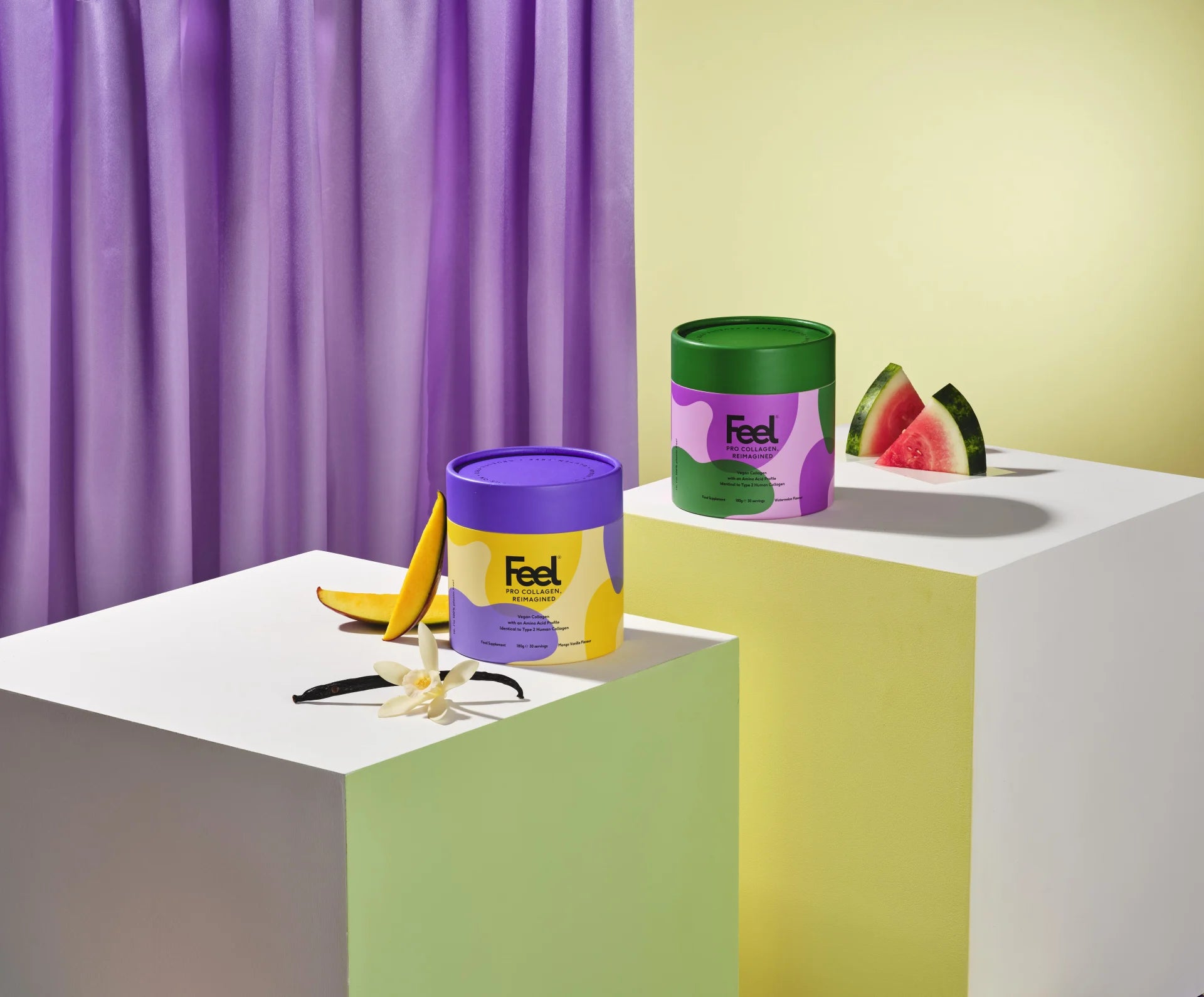
Feel Pro Collagen Type 2 in mango and in watermelon on white plinths, with mango slices, a vanilla flower and watermelon wedges, in front of a violet curtain

The formula in these studies

Feel Pro Collagen Type 2: the building blocks of type 2 collagen, in one drink a day

Each 6 g serving carries 5.1 g of the Type 2 blend: 18 amino acids in the proportions of human type 2 collagen, with vitamin C and turmeric and elderberry extracts. Vegan, in mango or watermelon. Stir two level teaspoons into 200 to 300 ml of water, once a day.

  • 5.1 g Type 2 blend per serving
  • 153 mg vitamin C
  • 30 servings, 1 a day

Vitamin C contributes to normal collagen formation for the normal function of cartilage and bones. Food supplements are not a substitute for a varied, balanced diet and a healthy lifestyle.

Flowchart

How to take it

  1. Two level teaspoons a day6 g stirred into 200 to 300 ml of water; no more than two servings a day.
  2. Every day, for 12 weeks or moreThe study measured its results after 12 weeks.
  3. Keep movingRegular joint movement and load help keep cartilage healthy, the cartilage review notes.

Evidence summary

What was measured, and how strong is each result?

Each result on this page, labelled by the kind of study behind it.

Chart

14 results, sorted by the kind of evidence

Every result on this page about the formula or its vitamin C.

  • 7In people, without a comparison group the WOMAC score and its three parts, two spine bone scores and CTx (study 1).
  • 6In cells in the laboratory collagen gene, glycosaminoglycans, inflammation signals, nitric oxide and two bone cell tests (study 2).
  • 1An approved health claim vitamin C and collagen formation.

Drawn by Feel. Studies 3, 4 and 5 review or compare other research and are not counted here.

Explainer

Where these results sit on the ladder of evidence

From the weakest kind of evidence to the strongest.

  • Laboratory testsClues to how an ingredient might work.Study 2
  • A study with no comparison groupShows what happened to people, not what would have happened without the product.Study 1
  • A placebo-controlled trialOne group takes the product, another a look-alike; the results are compared.Not yet
  • Several trials pooledResearchers combine many trials to get a clearer answer.Not yet

The ladder the Feel science pages use. The published trials in study 3 tested other collagen ingredients. Study 5 sets study 1’s result next to other studies and adds no new result.

Read before you decide

How strong is this evidence?

A fair appraisal, the way a clinician would read it.

Strengths

  • The same ingredient and amount. Study 1 gave 5 g a day of the Type 2 blend; one serving holds 5.1 g.
  • Several measures. A standard joint questionnaire (WOMAC), spine bone scans and a blood marker, at the start and after 12 weeks.
  • The right cells. The laboratory tests looked at the cells that build cartilage and bone.
  • An approved claim. Vitamin C contributes to normal collagen formation for the normal function of cartilage and bones.

Limits

  • No comparison group. Everyone took the formula, so the changes cannot be separated from time, expectation or other habits.
  • Small. 10 people, and fewer for the bone and blood results.
  • Not peer-reviewed. Both reports come from the ingredient’s maker and give no authors, date or full statistics.
  • Cells are not joints. The laboratory tests do not show what happens inside a joint.
  • Short. Bone and cartilage change slowly; 12 weeks is short for both.
  • Other collagens. The trials in the 2023 review tested native or hydrolysed collagen, not this formula.
  • Comparisons across studies. Study 5 sets separate studies side by side; they differ in people, design and length, so it cannot show which supplement works best.

Questions

Questions people ask

Is Pro Collagen Type 2 real collagen?

It contains no collagen from animals. It gives the body the building blocks of type 2 collagen instead: 18 amino acids in the proportions found in human type 2 collagen, with vitamin C, which contributes to normal collagen formation for the normal function of cartilage and bones. The 2023 review on this page notes that products sold as vegan collagen are blends of amino acids, vitamins, minerals and plant extracts, and contain no actual collagen.

What is the difference between type 1 and type 2 collagen?

Type 1 is the main collagen of skin, bone, tendons and ligaments; type 2 is the main collagen of joint cartilage, about 80% of the collagen there in one review and 90% to 95% in another. Type 1 is made of two identical chains and one different chain; type 2 of three identical chains. Feel Pro Collagen follows the type 1 profile for skin; Pro Collagen Type 2 follows the type 2 profile for joints.

Has Pro Collagen Type 2 been tested in people?

Its Type 2 blend was tested by the blend’s maker in 10 adults at 5 g a day for 12 weeks, the amount in one serving. Their joint questionnaire score was 58% lower than at the start. The study had no placebo group and has not been published in a journal, so it is an early result.

How long until I notice a difference?

In the study, the joint questionnaire score was already 41.2% lower than at the start after 4 weeks of daily use, and 58.0% lower after 12 weeks; the study had no placebo group. Cartilage itself renews slowly: its collagen is estimated to last for decades, so think of it as a long-term habit. Results differ from person to person.

How much should I take?

Two level teaspoons (6 g) a day, stirred into 200 to 300 ml of water. Do not take more than two servings a day.

What does the WOMAC score measure?

The Western Ontario and McMaster Universities Osteoarthritis Index (WOMAC) is a standard questionnaire on joint pain, stiffness and how easily you manage everyday movements: 24 questions, 5 on pain, 2 on stiffness and 17 on everyday movement, each answered on a scale from none to extreme. Added up, the score runs from 0 to 96, and a lower score means milder symptoms. It was tested in 1988 and is one of the questionnaires joint studies use most.

How does Pro Collagen Type 2 compare with other joint supplements?

No study has tested it against another supplement. In the maker’s comparison of 75 trials that used the same questionnaire, the Type 2 blend’s 58.0% fall at 12 weeks was the 5th largest of 44 supplement groups, and the middle result was a 34.9% fall. These are falls from each group’s own start in separate studies, most of which had a placebo group while the Type 2 blend’s did not, so the comparison shows where the result sits, not which supplement works best.

Is it suitable for vegans?

Yes. Pro Collagen Type 2 is vegan and contains no collagen from animals.

Who should not take it?

If you are pregnant, breastfeeding or taking medication, talk to your doctor before use. Keep it out of the sight and reach of children.

Key facts

The facts in one place

Sentences that each stand on their own and link to where they are shown.

  • Feel Pro Collagen Type 2 for Joints gives 5.1 g of the Type 2 blend in each 6 g serving: 18 amino acids in the proportions found in human type 2 collagen, with elderberry extract, turmeric extract and 153 mg of vitamin C. See the ingredients
  • In the maker’s 12-week study of 10 adults taking 5 g a day, the average WOMAC score for joint pain, stiffness and everyday movement was 58.0% lower than at the start; the study had no comparison group. See study 1
  • In the same study, stiffness scores fell 66.7%, physical function scores 60.5% and pain scores 44.0%. See study 1
  • In the same study, the WOMAC score was already 41.2% lower than at the start at week 4. See the questionnaire results
  • The WOMAC questionnaire has 24 questions, 5 on pain, 2 on stiffness and 17 on everyday movement, each scored from 0 to 4, for a total of 0 to 96 points. See what it asks
  • In the maker’s comparison of 75 joint-supplement trials, the Type 2 blend’s 58.0% fall at 12 weeks was the 5th largest of 44 supplement groups; the middle result was 34.9%. The comparison sets separate studies side by side. See the comparison
  • In the same study, CTx, a blood marker of bone breakdown, fell 19.7%, from 0.493 to 0.396 ng/mL, in 8 adults. See study 1
  • In the maker’s laboratory tests in cartilage cells, the formula raised the activity of the type 2 collagen gene by up to 50% and increased glycosaminoglycans. See study 2
  • Studies of other collagen ingredients for joints used native type 2 collagen at about 40 mg a day or hydrolysed collagen at 5 to 10 g a day; 22 of the 24 studies in a 2023 review reported improvements. See study 3
  • Type 2 collagen makes up 90% to 95% of the collagen in joint cartilage, and collagen is about 60% of cartilage’s dry weight. See study 4
  • Vitamin C contributes to normal collagen formation for the normal function of cartilage and bones; one serving gives 153 mg, 191% of the reference intake. See the ingredients

Check it yourself

The papers, and where to find them

Timeline

When each source was published

  1. The WOMAC questionnaire testedJournal of Rheumatology
  2. The placebo reviewAnnals of the Rheumatic Diseases
  3. Study 4: the cartilage reviewSports Health
  4. The review of collagen trials with a placebo groupInternational Orthopaedics
  5. Study 3: the collagen reviewNutrients
  6. Studies 1 and 2: the maker’s reportDate from the file’s name; the report itself is undated
  7. Study 5: the maker’s comparisonUndated; it includes trials published up to 2025

The journals’ dates as printed. The maker’s report is undated: its date comes from the name of Feel’s copy of the file. The eight trials in the joint questionnaire chart are listed after these sources.

Studies 1 and 2Company reportThe ingredient’s maker · Not peer-reviewed
VeCollal Type 2: Clinical Trial Result. Company report from the maker of the ingredient; no authors, date or laboratory given. Not peer-reviewed.
Study 3ReviewMartínez-Puig et al. · Nutrients · 2023
Martínez-Puig D, Costa-Larrión E, Rubio-Rodríguez N, Gálvez-Martín P. Collagen supplementation for joint health: the link between composition and scientific knowledge. Nutrients. 2023;15(6):1332. doi:10.3390/nu15061332
Study 4ReviewSophia Fox et al. · Sports Health · 2009
Sophia Fox AJ, Bedi A, Rodeo SA. The basic science of articular cartilage: structure, composition, and function. Sports Health. 2009;1(6):461-468. doi:10.1177/1941738109350438
Study 5Company documentThe ingredient’s maker · Not peer-reviewed
Jiménez Vázquez J. Efficacy of nutraceutical supplements for joint health: a meta-analysis. Company document from the maker of the ingredient; undated, covering trials published up to 2025. Not peer-reviewed.
The questionnaireValidation studyBellamy et al. · Journal of Rheumatology · 1988
Bellamy N, Buchanan WW, Goldsmith CH, Campbell J, Stitt LW. Validation study of WOMAC: a health status instrument for measuring clinically important patient relevant outcomes to antirheumatic drug therapy in patients with osteoarthritis of the hip or knee. J Rheumatol. 1988;15(12):1833-1840.
PlaceboMeta-analysisZhang et al. · Annals of the Rheumatic Diseases · 2008
Zhang W, Robertson J, Jones AC, Dieppe PA, Doherty M. The placebo effect and its determinants in osteoarthritis: meta-analysis of randomised controlled trials. Ann Rheum Dis. 2008;67(12):1716-1723. doi:10.1136/ard.2008.092015
Collagen trialsMeta-analysisGarcía-Coronado et al. · International Orthopaedics · 2019
García-Coronado JM, Martínez-Olvera L, Elizondo-Omaña RE, Acosta-Olivo CA, Vilchez-Cavazos F, Simental-Mendía LE, Simental-Mendía M. Effect of collagen supplementation on osteoarthritis symptoms: a meta-analysis of randomized placebo-controlled trials. Int Orthop. 2019;43(3):531-538. doi:10.1007/s00264-018-4211-5
Further readingTextbook chapterStatPearls · NCBI Bookshelf
StatPearls chapter on chondrocytes, the cells of cartilage. NCBI Bookshelf, NBK557576. National Library of Medicine, United States.

The eight trials in the joint questionnaire chart

Turmeric extract, 500 mgTrialPanda et al. · BioMed Research International · 2018
Panda SK, Nirvanashetty S, Parachur VA, Mohanty N, Swain T. A randomized, double blind, placebo controlled, parallel-group study to evaluate the safety and efficacy of Curene® versus placebo in reducing symptoms of knee OA. Biomed Res Int. 2018;2018:5291945. doi:10.1155/2018/5291945
Curcuminoids, 1.5 gTrialPanahi et al. · Phytotherapy Research · 2014
Panahi Y, Rahimnia AR, Sharafi M, Alishiri G, Saburi A, Sahebkar A. Curcuminoid treatment for knee osteoarthritis: a randomized double-blind placebo-controlled trial. Phytother Res. 2014;28(11):1625-1631. doi:10.1002/ptr.5174
Turmeric and glucosamineTrialMadhu et al. · Inflammopharmacology · 2013
Madhu K, Chanda K, Saji MJ. Safety and efficacy of Curcuma longa extract in the treatment of painful knee osteoarthritis: a randomized placebo-controlled trial. Inflammopharmacology. 2013;21(2):129-136. doi:10.1007/s10787-012-0163-3
Glucosamine sulfate, 1.5 gTrialGiordano et al. · Current Therapeutic Research · 2009
Giordano N, Fioravanti A, Papakostas P, Montella A, Giorgi G, Nuti R. The efficacy and tolerability of glucosamine sulfate in the treatment of knee osteoarthritis: a randomized, double-blind, placebo-controlled trial. Curr Ther Res Clin Exp. 2009;70(3):185-196. doi:10.1016/j.curtheres.2009.05.004
MSM, 6 gTrialKim et al. · Osteoarthritis and Cartilage · 2006
Kim LS, Axelrod LJ, Howard P, Buratovich N, Waters RF. Efficacy of methylsulfonylmethane (MSM) in osteoarthritis pain of the knee: a pilot clinical trial. Osteoarthritis Cartilage. 2006;14(3):286-294. doi:10.1016/j.joca.2005.10.003
MSM, 3.4 gTrialDebbi et al. · BMC Complementary and Alternative Medicine · 2011
Debbi EM, Agar G, Fichman G, Ziv YB, Kardosh R, Halperin N, Elbaz A, Beer Y, Debi R. Efficacy of methylsulfonylmethane supplementation on osteoarthritis of the knee: a randomized controlled study. BMC Complement Altern Med. 2011;11:50. doi:10.1186/1472-6882-11-50
Native type 2 collagen, 40 mgTrialLugo et al. · Nutrition Journal · 2016
Lugo JP, Saiyed ZM, Lane NE. Efficacy and tolerability of an undenatured type II collagen supplement in modulating knee osteoarthritis symptoms: a multicenter randomized, double-blind, placebo-controlled study. Nutr J. 2016;15:14. doi:10.1186/s12937-016-0130-8
Collagen, chondroitin, glucosamineTrialPuigdellivol et al. · Journal of Dietary Supplements · 2019
Puigdellivol J, Comellas Berenger C, Pérez Fernández MÁ, Cowalinsky Millán JM, Carreras Vidal C, Gil Gil I, Martínez Pagán J, Ruiz Nieto B, Jiménez Gómez F, Comas Figuerola FX, Aguilar Hernández ME. Effectiveness of a dietary supplement containing hydrolyzed collagen, chondroitin sulfate, and glucosamine in pain reduction and functional capacity in osteoarthritis patients. J Diet Suppl. 2019;16(4):379-389. doi:10.1080/19390211.2018.1461726

Formula note. One 6 g serving of Feel Pro Collagen Type 2 for Joints provides 5.1 g of VeCollal® Type 2, with 0.25 g of elderberry extract, 0.05 g of turmeric extract and 153 mg of vitamin C (191% of the reference intake), and 4.6 g of protein, in 22 kcal. Ingredients (mango): VeCollal® Type 2 (glycine, L-proline, L-alanine, L-aspartic acid, L-glutamine, elderberry extract powder, L-glutamic acid, L-arginine, L-lysine monohydrochloride, L-serine, L-leucine, ascorbic acid, L-threonine, L-valine, L-methionine, L-isoleucine, L-phenylalanine, turmeric extract, L-tyrosine, L-histidine, L-tryptophan), natural mango flavour, citric acid, maltodextrin, natural peach flavour, steviol glycosides, natural flavour, beta carotene (colour), vanilla flavour. One serving a day; no more than two. 30 servings (180 g).

This page summarises research on the ingredients for general information. It is not medical advice. Feel Pro Collagen Type 2 is a food supplement and is not intended to diagnose, treat, cure or prevent any disease. If you have a joint or bone condition, are pregnant or breastfeeding, or take medication, talk to your doctor before use.